
Missing teeth change more than how a smile looks. They change how you bite into an apple, how clearly you pronounce certain sounds, and how the bone in your jaw shapes your face over the years. Dental implants are the most durable, natural-feeling way modern dentistry can replace a missing tooth. At Delaware Star Dental in Wilmington, Dr. Sattar A. Syed, DMD, MAGD, DABOI, DICOI restores smiles with precise digital planning, gentle surgical technique, and crowns that blend seamlessly with the teeth around them. He is the only dentist in Delaware to hold both an AGD Mastership (MAGD) and Diplomate-level certifications in implantology from both the American Board of Oral Implantology (DABOI) and the International Congress of Oral Implantologists (DICOI).
What is a Dental Implant?
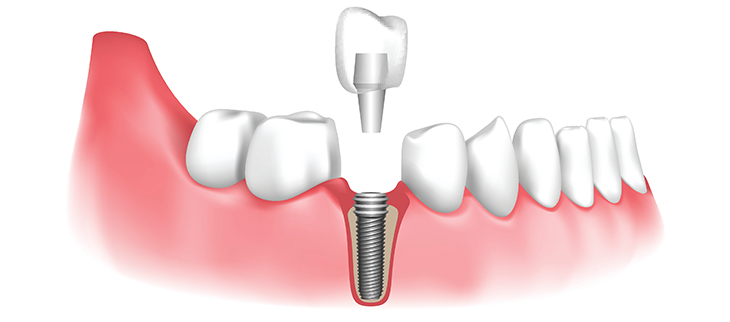
A dental implant is a three-part restoration that mimics the structure of a natural tooth. The first part is a small titanium post that is placed surgically into your jawbone, where it acts like an artificial tooth root. Titanium is biocompatible — over a healing period of a few months, your bone grows around the post and fuses with it in a process called osseointegration. The second part is the abutment: a small connector that screws into the implant and sits at the gum line. The third part is the crown — the visible "tooth" that gets cemented or screwed onto the abutment. Because the post is anchored in living bone, an implant feels and functions like a natural tooth, not a removable appliance.
Am I a Candidate for Dental Implants?
Most healthy adults are good candidates. The main considerations are bone volume in the implant site, the health of your gums, and any conditions or medications that could affect healing. Patients who have been missing a tooth for years sometimes need bone grafting before the implant can be placed — this is common and predictable. Patients with uncontrolled diabetes, heavy smokers, and patients on certain bone-density medications need a more careful evaluation. The fastest way to know for sure is a complimentary consultation: we'll take a cone-beam CT scan, walk through your jaw anatomy on screen with you, and give you a written answer about whether implants are right for you.
Our Implant Process, Step by Step
Every implant case at our office is digitally planned before we touch a drill. That's how we keep visits predictable.
- Free consultation and 3D imaging — we map your jaw, sinus position, and surrounding teeth with a low-radiation cone-beam CT scan.
- Personalized treatment plan with a written quote, timeline, and any preparatory work (extractions, grafting) clearly listed.
- Implant placement — a precise surgical visit under local anesthesia, typically 45 to 90 minutes per implant. Most patients are comfortable enough to drive home.
- Healing and osseointegration — three to six months while the bone integrates with the implant. A temporary tooth is provided when aesthetics matter.
- Final restoration — your custom crown (or bridge, or full arch) is designed digitally, fabricated by a master ceramist, and seated at your final appointment.
Single Implants, Multiple Implants, and Full-Arch Options
A dental implant doesn't have to be a single-tooth solution. We use the same proven implant foundation to support a range of restorations.
- Single tooth replacement — one implant and one crown, the gold standard for a missing tooth.
- Implant-supported bridge — two implants anchor a bridge that replaces three or more adjacent teeth, without grinding down healthy neighboring teeth.
- Implant-supported dentures — a removable denture that snaps onto a small number of implants, eliminating slippage and adhesive.
- Full-arch fixed restorations (often called All-on-4 or All-on-X) — four to six implants permanently support a full set of upper or lower teeth in a single fixed bridge.
Caring for Your New Implant
Implant care is closer to caring for a natural tooth than most patients expect. Brush twice a day with a soft-bristled brush. Floss once a day — a floss threader or interdental brush makes it easier around the implant crown. Keep up with regular cleanings and exams every six months so we can monitor the implant, the bone level, and the surrounding gums. Avoid using your implant to crack hard candies, ice, or popcorn kernels, just as you'd avoid those with a natural tooth. With consistent home care and routine professional checkups, a dental implant routinely lasts 20 years or more, and often a lifetime.
Why Wilmington Patients Choose Delaware Star Dental for Implants
Dr. Syed is the only dentist in Delaware to hold both an Academy of General Dentistry Mastership (MAGD) and Diplomate-level board certifications in implantology from the American Board of Oral Implantology (DABOI) and the International Congress of Oral Implantologists (DICOI). Diplomate status is the highest credential each board confers — it requires extensive case documentation, oral examinations, and ongoing continuing education. He's also a Mastership-level dentist in the Academy of General Dentistry, an honor that requires 1,100 hours of continuing dental education. Patients from Pike Creek, Newark, Marshallton, Hockessin, and across New Castle County come to our Kirkwood Highway office for implant care because they can complete the full journey — from consultation through final restoration — without being shuffled between multiple specialists.